

Choosing between a crate and a kennel sounds simple until you realize how differently they function. Many pet owners use the terms interchangeably, but they are not the same thing, and picking the wrong one can affect your dog's comfort, training progress, and daily routine more than you might expect.
This guide covers what each option actually is, which type suits your dog's age and size, and what you should realistically budget for either.
Types of Dog Crates
What Is a Dog Crate?
A dog crate is a portable enclosure designed primarily for indoor use. It functions as a training tool, a safe retreat, and a travel solution. Crates work with a dog's natural denning instincts, and when introduced correctly, most dogs come to treat their crate as a personal space rather than a form of confinement.
Crates come in several materials and designs, each suited to different needs.

Wire Crates
Wire crates are the most popular choice for home use in the U.S. The open grid structure provides excellent ventilation and visibility, which helps anxious dogs feel less isolated. Most models fold flat for easy storage and include a removable divider panel, making it simple to start with a smaller space and expand it as a puppy grows. The open design is less ideal for dogs that feel more secure in an enclosed, cave-like space.
Plastic (Airline) Crates
Plastic crates, sometimes called travel kennels or airline carriers, are more enclosed than wire models, which many dogs actually prefer. They are the standard format for commercial air travel with pets. If you plan to fly with your dog, check that the crate meets IATA Live Animals Regulations before purchasing, as airlines enforce specific size and ventilation requirements.
Soft-Sided Crates
Soft-sided crates are lightweight and collapsible, making them a convenient choice for road trips, camping, and vet visits. They work best for calm, well-trained dogs, as the fabric construction offers little containment against a determined chewer or a dog prone to anxiety-driven escaping.
Furniture-Style Crates
Furniture-style crates are built from wood with a clean, finished look that blends into a living space rather than standing out as pet equipment. The flat top often doubles as a side table or display shelf, making them practical for smaller homes or open-plan interiors. Petscosset’s wooden dog crate with wheels comes in a medium size suited for dogs up to 35 lbs and a large size for medium to large breeds, so it works across a range of dog sizes without sacrificing style.

Types of Dog Kennels
What Is a Dog Kennel?
A dog kennel is a larger, more permanent structure meant to house a dog for extended periods. Unlike a crate, which is typically used indoors for short-term containment or training, a kennel gives a dog room to stand, move, and spend significant time comfortably. Kennels can be indoor pen-style enclosures or full outdoor structures.
Indoor Kennels
Indoor kennels are typically large paneled pens or run-style enclosures set up inside the home. They work well for dogs that need more space than a crate allows but are not yet ready to roam the house freely. They are common in multi-dog households and are often placed in laundry rooms, garages, or dedicated pet areas.
Boarding Kennels
Boarding kennels are commercial facilities where dogs stay while their owners are away. Dogs already familiar with a kennel-style space tend to adapt to boarding more easily, which is one practical reason to introduce a home kennel early in a dog's life.
Outdoor Kennels
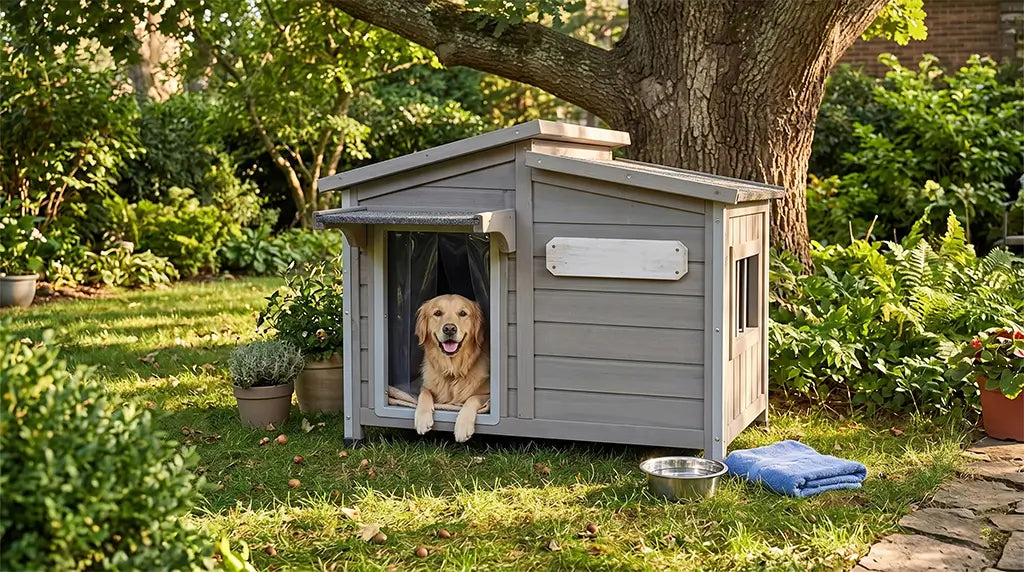
Outdoor kennels are freestanding structures placed in a backyard or garden. They range from basic open-run enclosures to fully enclosed wooden dog houses with weatherproof roofing, insulated walls, and raised floors. Petscosset’s collection of outdoor dog houses built for year-round use come in a range of sizes and construction styles suited to different breeds and climates.

Dog Crate vs. Kennel
|
Dog Crate |
Dog Kennel |
|
|
Primary use |
Training, short-term containment, travel |
Long-term housing, extended indoor or outdoor stays |
|
Typical size |
Compact, closely sized to the dog |
Spacious, room to move freely |
|
Location |
Indoors |
Indoors or outdoors |
|
Portability |
High (most fold flat or are lightweight) |
Low (semi-permanent or fixed structures) |
|
Best for |
Puppies, travel, house training |
Larger dogs, backyard use, multi-dog setups |
|
Typical materials |
Wire, plastic, fabric, wood |
Wood, metal, composite |
Dog Crates: Pros and Cons
Pros:
- One of the most effective house training tools available, helping dogs develop bladder control through consistent routine
- Gives dogs a defined personal space and reduces destructive behavior when used correctly
- Practical for safe vehicle transport and required for most commercial flights with pets
Cons:
- Requires proper introduction and positive reinforcement to be effective
- Can contribute to anxiety if used for too long; the American Kennel Club recommends that adult dogs not be crated for more than four to five hours at a stretch during the day
- Can feel restrictive for larger breeds during extended use
Dog Kennels: Pros and Cons
Pros:
- Offers significantly more space than a crate, better suited for extended stays
- Provides a defined territory that many dogs find naturally calming
- Purpose-built outdoor kennels offer reliable shelter through changing weather conditions
Cons:
- Not portable and requires dedicated floor or yard space
- Outdoor kennels need regular weatherproofing and maintenance to stay safe and comfortable year-round
- Higher upfront cost, particularly for solid wood or metal-reinforced structures

Which Is Right for Your Dog?
|
Situation |
Best Option |
|
Puppy being house trained |
Crate |
|
Small breed, indoor dog |
Crate or small indoor kennel |
|
Large breed with backyard access |
Outdoor kennel |
|
Frequent traveler |
Crate (plastic or soft-sided) |
|
Overnight indoor stays |
Crate or indoor kennel |
|
Dog with an outdoor lifestyle |
Outdoor kennel |
Best for Puppies and Crate Training
A crate is almost always the right starting point for a puppy. The enclosed space encourages bladder control because dogs naturally avoid soiling where they sleep, and it provides a safe way to manage a curious puppy when direct supervision is not possible. Choose a model with a divider panel so you can start with a smaller space and expand it gradually as your puppy grows, rather than sizing up to an adult crate too early.
For small breed puppies that will eventually spend time outdoors, this small outdoor dog house is sized for small to medium dogs and offers a weatherproof, sheltered space for when they are ready to move outside.
Best for Small Breeds
Small breeds adapt well to both crates and kennels, but the enclosed feel of a crate often suits them better for indoor use. If you are setting up outdoor space for a smaller dog, sizing matters more than most owners realize. A kennel that is too large can feel less secure rather than more comfortable. Small dog houses sized appropriately for the breed strike a better balance between space and security.
Best for Large Breeds
Large breeds need room to stand fully upright, turn around, and lie down stretched out. A standard crate can feel restrictive for a German Shepherd or a Labrador during extended use, and oversized wire crates can be cumbersome indoors. A properly sized outdoor kennel is often the more practical long-term solution for bigger breeds. Large dog houses with reinforced framing and weatherproof materials are built to hold up to the daily wear of larger, more active dogs.
Best for Overnight Use
For overnight indoor use, a crate works well for most dogs as long as it is properly sized. At minimum, your dog should be able to stand without ducking, turn around comfortably, and lie fully stretched out. For larger dogs that find a standard crate too snug through the night, an indoor kennel pen is the more comfortable alternative.
Best for Outdoor or Backyard Use
If your dog spends most of the day outside, a weatherproof outdoor kennel is the practical choice. Features worth prioritizing include:
- A raised floor to prevent moisture from the ground
- A waterproof or metal-reinforced roof
- Chew-resistant edges for dogs that tend to gnaw on wood
This backyard dog kennel for 2 dogs is built for one large dog or two medium dogs sharing the same outdoor space.

Best for Travel
For travel, a crate is the right choice in most situations. The best type depends on how you are traveling: plastic airline crates are required for commercial flights, soft-sided crates are more practical for road trips and weekend getaways, and wire crates offer the most versatility since they fold flat and work equally well at home and at a destination.
Cost Comparison
Average Cost of Dog Crates
|
Crate Type |
Typical Price Range |
|
Wire crate |
$30 – $120 |
|
Plastic (airline) crate |
$40 – $150 |
|
Soft-sided crate |
$30 – $100 |
|
Furniture-style crate |
$90 – $300+ |
Average Cost of Dog Kennels
Outdoor kennel prices vary more widely depending on size, material, and build quality. Basic metal run or chain-link enclosures start around $80 to $200, while solid wood outdoor dog houses typically range from $90 for smaller models to $370 or more for XL structures built for two dogs. Features like metal-reinforced edges, insulated walls, and weatherproof roofing increase the upfront cost but extend the usable lifespan considerably, making them better value over time.
Final Verdict
Neither option is universally better. Crates and kennels serve genuinely different purposes, and the right choice depends on your dog's age, size, temperament, and daily routine.
Many owners end up using both: a crate indoors for training and overnight use, and an outdoor kennel for daytime backyard time. That setup gives your dog a defined, comfortable space for every part of their routine.


Share:
7 Cat Window Box Mistakes to Avoid Before Buying
What to Put Inside an Outdoor Dog House: Full Season Setup Guide